
Forrest Projected Versus Actual Release
A projected date is a calculation. An actual release is a completed custody event. The distinction is critical in Forrest County because the Adult Detention Center holds pretrial detainees and local prisoners, while the nearby Community Work Center belongs to MDOC. The same local name can point to two different systems.
A state prisoner may have an ERS date, tentative release date, and maximum release date. A county pretrial detainee may have none. When release happens, use the jail release transaction or MDOC discharge documentation to confirm it. If another agency receives the person, the event is a transfer rather than return to the community.
Note: Identify the last custodian before reading a date because county and MDOC records calculate and confirm different release events.
Find a Forrest Release Date
Begin with the last facility that held the person. Do not apply a state-prison calculation to the county jail. Use an MDOC number for a state search and a booking number for the Adult Detention Center. Those identifiers connect the correct sentence or booking episode.
- Identify county jail, MDOC, federal, or immigration custody.
- For MDOC, search by number or name and match identity fields.
- Record “Tentative Release Date” exactly as displayed.
- Review the sentence, county of conviction, and current location or status.
- For county custody, obtain the judgment and ask jail time-computation staff.
- Check for holds, corrected credit, parole action, or revocation.
- After the event, obtain the release entry or discharge certificate.
The MDOC inmate search applies to state records. A Forrest County defendant who bonds out without a state commitment may never appear for that episode. The jail and court remain the right sources.
Forrest Tentative Release Date Rules
The public MDOC detail uses the precise label “Tentative Release Date.” Its broader record can show MDOC ID, entry date, location, unit, sentence count and length, offense, county of conviction, sentence date, physical descriptors, and a photograph. Compare these fields before relying on a namesake result.
The MDOC supervision definitions say ERS, tentative, and maximum dates are separately calculated. ERS is supervised release for eligible people. Parole depends on Board discretion. Maximum release reflects another endpoint. None should be renamed “confirmed release.”
This state computation does not apply to a Forrest County pretrial detainee. The county court controls bond and case orders, and the jail clears holds and processes the exit. MDOC calculates state sentences and credits only after a commitment to its custody. That local split prevents a tentative state date from being attached to the wrong person or facility.
The official MDOC detail example shows how the tentative field appears. The example is not proof of a released Forrest County person.
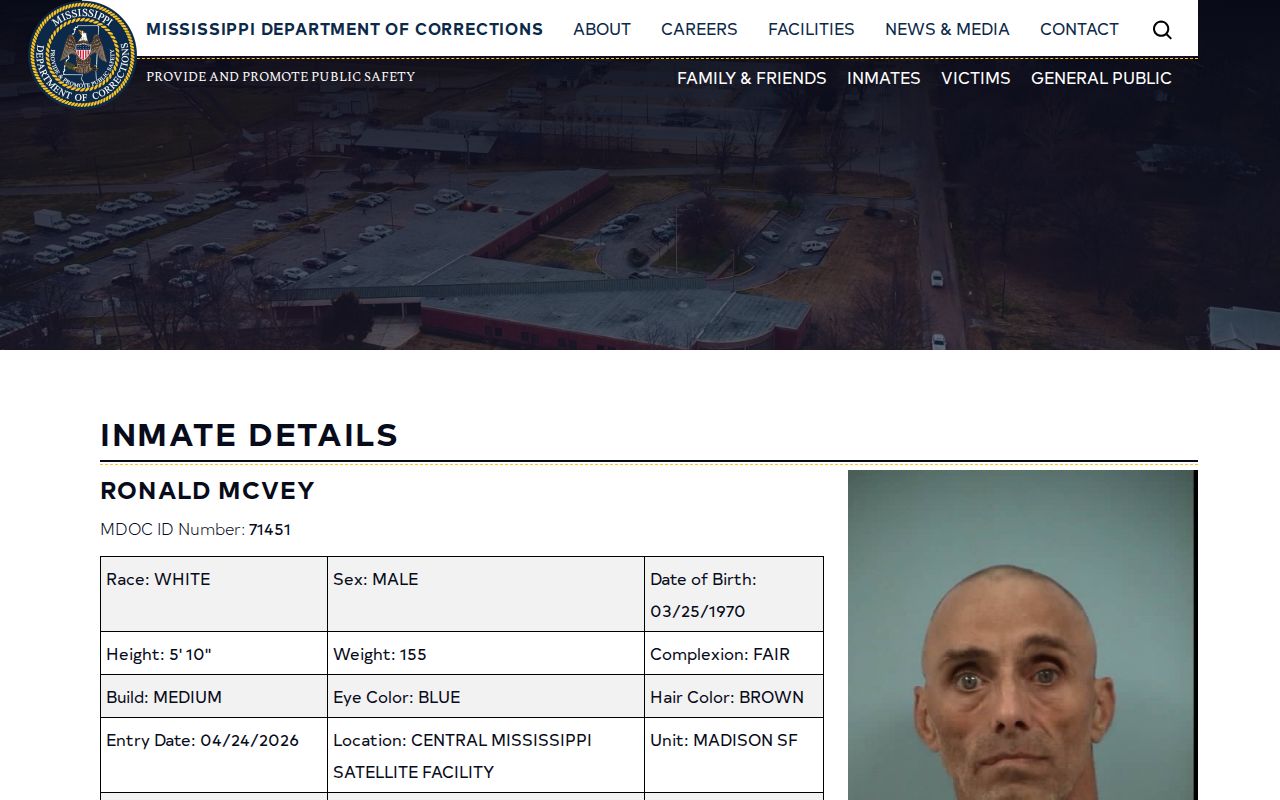
The image helps locate the field, while MDOC's live record remains the source for current data.
Mississippi Earned-Time Rules
Miss. Code § 47-5-138 governs earned time and must be read with § 47-5-139, which identifies ineligible categories. Offense, sentence date, statutory amendments, classification, discipline, mandatory terms, and other sentences or holds can affect the computation.
The often repeated 85-percent shorthand is not a promise that every prisoner leaves on one date. It reflects limits in the statutory framework for eligible people. MDOC performs the calculation. A reader should not subtract a percentage from the sentence and announce a Forrest County release date.
- Earned time
- A statutory credit applied by MDOC when the person and sentence qualify.
- ERS
- An eligible supervised release path calculated within the state sentence.
- Tentative date
- A forward-looking MDOC calculation that can change.
- Maximum date
- A separately calculated endpoint, not a synonym for parole.
The official MDOC supervision source visually separates the state release and supervision terms.
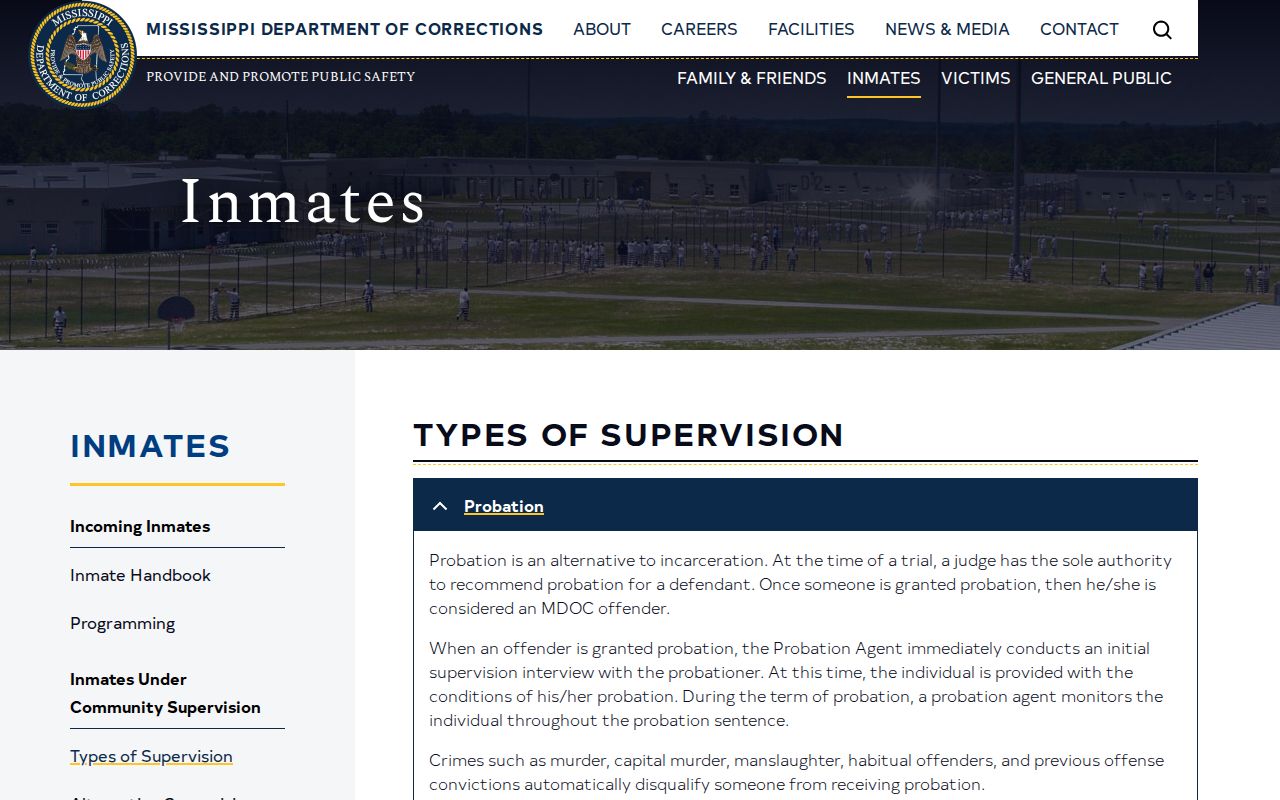
The captured definitions support reading ERS, tentative, and maximum dates as separate calculations rather than one promised release day.
Note: The 85-percent shorthand cannot replace MDOC's person-specific calculation under the statutes, sentence facts, credits, and eligibility rules.
Why Forrest Release Dates Change
Dates move when the legal or administrative inputs change. Corrections to jail credit, a new sentence, a revocation, loss or restoration of earned time, a detainer, or recalculation can alter the displayed result. Parole Board action creates another path, but eligibility and a hearing are not physical release.
| Change | Possible effect |
|---|---|
| Corrected jail credit | MDOC recalculates time credited before sentence. |
| Disciplinary action | Earned-time treatment may change under governing rules. |
| New sentence or order | The legal term or relationship among sentences changes. |
| Detainer or hold | Release may be delayed or redirected to another agency. |
| Parole or ERS action | A supervised path may become available or be revised. |
| Revocation | Community placement may end and custody resume. |
Read the updated MDOC record instead of relying on a saved date. Ask for time-computation confirmation when the public detail does not explain the change.
Verify Forrest MDOC Date Fields
An MDOC result must be matched before any date is used. Search by MDOC ID when possible. A name search can return a namesake, so compare date of birth, physical descriptors, county of conviction, offense, sentence date, sentence length, entry date, location, and unit. County of conviction links the sentence to Forrest County. It does not mean the person is held in Forrest County.
Read each date in its own field. The location-change date concerns placement, not release. The sentence date marks the legal term, not the projected exit. The Tentative Release Date is a current computation. ERS and maximum dates have separate meanings, and an actual parole or discharge status must be recorded apart from all of them.
| MDOC field | Question it answers | What it cannot prove |
|---|---|---|
| MDOC ID | Which state record belongs to the person | County booking identity by itself |
| County of conviction | Which county produced the sentence | Present placement |
| Location and change date | Reported state placement and movement | Community release |
| Tentative Release Date | Current forward-looking computation | Completed discharge |
| Parole, ERS, or discharge status | Reported release or supervision pathway | The full underlying court history |
Save the date and status wording with the date the record was viewed. State calculations can change. When the public detail conflicts with a judgment or older copy, send the MDOC number and relevant order to Records for time-computation confirmation rather than performing an independent percentage calculation.
Forrest County Jail Dates
A pretrial detainee generally has no sentence-completion date. Release depends on bond, a court order, case resolution, or another hold. For a local sentence, inspect the judgment and ask the Adult Detention Center how jail credit and the court's terms are implemented. MDOC prison earned-time rules should not be applied automatically.
A judge may sign an order before jail staff clear warrants, detainers, and paperwork. The court time and release-log time can differ. Ask for both records if the exact event matters. A transfer to MDOC, USMS, ICE, or another county ends Forrest County physical custody but does not mean release to the community.
Note: The court supplies legal authority, while the jail release entry supplies the completed Forrest County exit time and destination.
Forrest MDOC Release Planning
The MDOC FAQ describes release preparation and says parole and ERS dates are not guaranteed. It also describes a process that can take 30 to 45 days. That statement concerns administrative preparation. It is not an instruction to add that span to the tentative date.
Release planning may include a case manager, an approved residence, supervision arrangements, detainer clearance, and discharge paperwork. The State Parole Board makes parole decisions, while MDOC handles state computation and supervision. Keep each role distinct.
Forrest Parole Date Limits
Parole eligibility is another date, not an order of release. Miss. Code § 47-7-3 contains rules and exclusions that depend on the offense, sentence, and date. The Mississippi State Parole Board decides eligible cases. A first eligibility date means consideration may occur; it does not predict the decision.
A Board grant can also precede physical release. MDOC may still need to complete planning, verify an approved residence, clear detainers, and satisfy other legal prerequisites. A denial, continuance, set-off, rescission, or revocation leads to a different path. Use the exact Board action rather than converting a hearing date into a projected exit.
Forrest County's role is the conviction and court record. The state Board decides parole, and MDOC prepares the release and supervises it. The Circuit Clerk does not compute the MDOC tentative date or decide parole.
Request Forrest Release Computations
When the public state detail does not resolve a date, ask MDOC Records for a public sentence or time sheet, release/status record, or discharge certificate. Use the MDOC number, full name, and the minimum identity details needed to locate the correct file. Ask for an electronic response and an itemized estimate before chargeable work.
P.O. Box 24388
Jackson, MS 39225
601-933-2889
MDOCRecordsDepartment@mdoc.state.ms.us
The published administrative schedule lists a $2 minimum, $0.25 per letter-size page, $0.35 per legal-size page, $10 per staff hour, and postage. An estimate may require prepayment by cashier's check or money order. Verify current terms before paying. Protected medical, victim, personal, and security information can be removed from a public response.
For a local jail sentence, address the question to the court and Adult Detention time-computation staff instead. Provide the booking number and judgment. Ask how jail credit and the stated term were applied. Do not ask MDOC to calculate a county sentence it does not hold.
Note: Use the MDOC number for a state computation request and the county booking number for a local jail-time question.
Confirm Forrest Actual Release
For a state prisoner, inspect the updated status and request a discharge certificate or public time sheet from MDOC Records when needed. For the county jail, request the booking/release entry. For federal custody, use BOP and the federal court. For ICE, use its locator and detention contacts.
A completed state record should distinguish the institutional exit from any supervision that follows. Record the actual status, release or discharge date, supervision type, and responsible office when those fields are public. A parole or ERS placement means the person may be outside prison while still subject to MDOC supervision. An unconditional discharge is a different endpoint.
For the Adult Detention Center, ask for the booking number, release timestamp, release reason, court or agency authority, and destination. That destination resolves whether the county event led to the community or another custodian. A signed order may explain why release was authorized, but the jail entry proves that processing was completed.
A VINE alert can provide notice of a reported event, and the Forrest County VINELink inmate search explains registration. The home page covers the full named-person search and county release record. Neither a notification nor a projected date replaces final agency confirmation.
Public Record Search
Sponsored Results